
I once watched a friend debate for forty minutes over whether to buy a $12 phone charger. The one he had was fraying, the metal wires already showing. He knew it would eventually stop working, maybe ruin the phone. But he kept turning it over in his hands like a puzzle.
“I’ll grab one next paycheck,” he said.
A few weeks later it shorted out overnight and fried his phone.
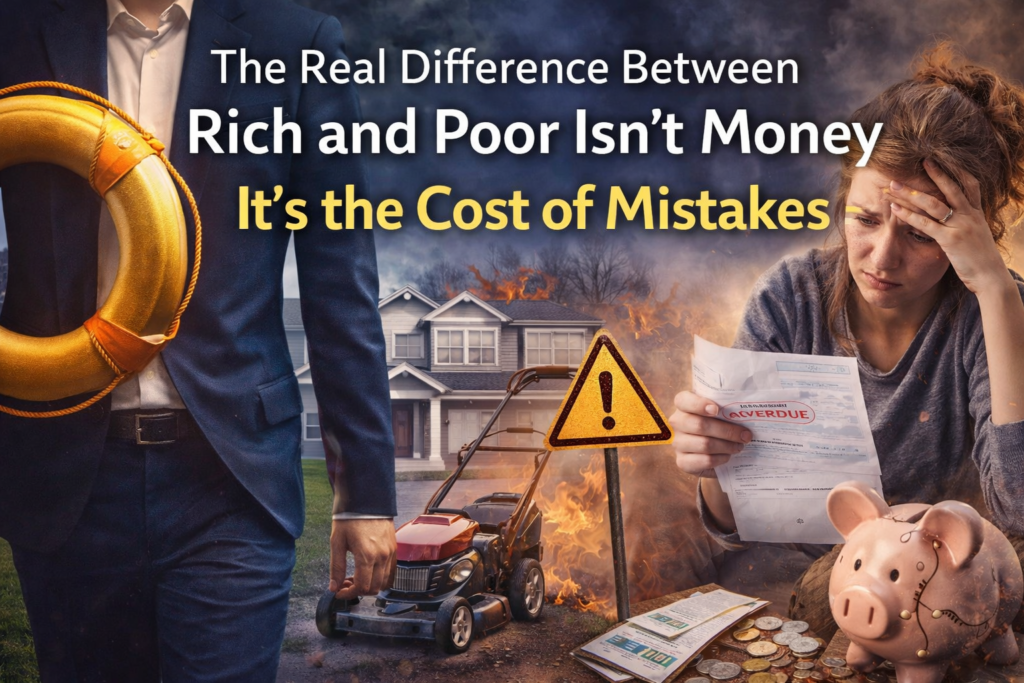
People like to frame the difference between rich and poor as lifestyle. Vacations, houses, cars. Those things are visible, which makes them easy to talk about. But the deeper difference shows up in quieter moments like that one. The real divide isn’t what people can buy. It’s what happens when they get something wrong.
Because mistakes cost very different amounts depending on how much cushion you have.
When Failure Is an Inconvenience
If you grow up with money around you, failure has guardrails.
You can change majors three times. Quit a job that feels wrong. Move to another city because you “need a fresh start.” Start a small business that collapses after eight months. None of those choices are painless, but they rarely destroy your life.
There’s always a floor beneath you. Parents who can help with rent. Savings you didn’t earn but can still lean on. A social network that quietly catches you.
That safety net changes the emotional math of every decision.
Risk starts to feel exciting instead of terrifying. Confidence looks like a personality trait, when in reality it’s often just a financial condition.
When One Bad Decision Echoes for Years
For people living closer to the edge, mistakes don’t fade quietly into the background. They echo.
A bad car purchase isn’t just a bad purchase. It becomes missed work, repair bills, maybe a job lost because the commute stops working.
A single medical bill can wipe out the emergency fund that took years to build. A broken appliance becomes two months of juggling expenses. A bad semester in college can turn into student loans that follow you for decades.
Every decision carries a shadow behind it.
So people become careful. Deliberate. Sometimes painfully slow to act.
From the outside it looks like hesitation. Lack of ambition. Fear.
From the inside it looks like survival.
Why Risk Looks Different From Different Heights
This is why conversations about risk often feel like two people speaking different languages.
Someone with a safety net might say, “Just try it. If it doesn’t work, you can always start over.”
But “starting over” is a luxury phrase.
If you’re already balancing rent, debt, and unpredictable expenses, starting over isn’t romantic. It’s catastrophic.
The cost of missing your shot isn’t embarrassment. It’s instability.
So people stay in jobs they hate. They delay ideas that might work. They choose the steady path even when they know the upside is smaller.
Not because they lack imagination, but because they understand consequences very clearly.
The Freedom Rich People Rarely Notice
There’s a type of freedom that doesn’t show up in bank balances or Instagram photos.
It’s the freedom to recover quickly.
To take a wrong turn and simply redirect.
To fail publicly and keep going because nothing truly collapses underneath you.
People who have always had that freedom often don’t notice it. It feels normal, like air. They assume everyone else has the same invisible cushion.
So when someone else plays life cautiously, the assumption becomes character judgment.
Lazy. Unmotivated. Risk-averse.
But what they’re really seeing is someone calculating the price of being wrong.
The Strange Psychology of Scarcity
Scarcity does something subtle to the brain.
You start optimizing everything. Groceries are chosen based on what will expire first, not what you feel like eating. Purchases are delayed until the last possible moment. Objects get repaired long after most people would replace them.
This mindset doesn’t switch off easily.
Even years later, when life improves, many people still carry the habits. They check bank balances before buying dinner. They keep old cords, containers, appliances that “still work.”
Because they remember how expensive the wrong decision used to be.
The Confidence Gap That Isn’t About Personality
Confidence is often described as something internal. A belief in yourself. A personality trait.
But watch who takes the biggest swings in life and you’ll notice something else quietly operating in the background.
The people who seem fearless usually have room to land.
The ones who appear cautious are often balancing much tighter margins.
Put anyone on a trampoline and they’ll jump higher. Put them on a tightrope and they’ll move slowly.
From a distance it can look like bravery versus hesitation.
Up close it’s usually just physics.
The Small Moments Where the Divide Shows Up
You see the difference in ordinary places.
In a grocery store, when someone casually adds things to their cart based on cravings while someone else mentally calculates the total before each item goes in.
At work, when one person speaks confidently about quitting if things get worse while another quietly stays late because losing the job isn’t an option.
On vacations, when one friend suggests extending the trip another three days without considering that someone else budgeted the entire week down to the last meal.
These aren’t dramatic scenes. They happen quietly, every day.
But they reveal something fundamental about how differently people experience the same world.
Why This Difference Shapes Entire Lives
Once you start noticing the cost of mistakes, it becomes difficult to unsee.
It explains why some people move boldly through life while others measure every step.
It explains why confidence often clusters in the same social circles where safety nets already exist.
And it explains something people rarely say out loud.
The distance between rich and poor isn’t just built from money.
It’s built from how expensive it is to be wrong.