
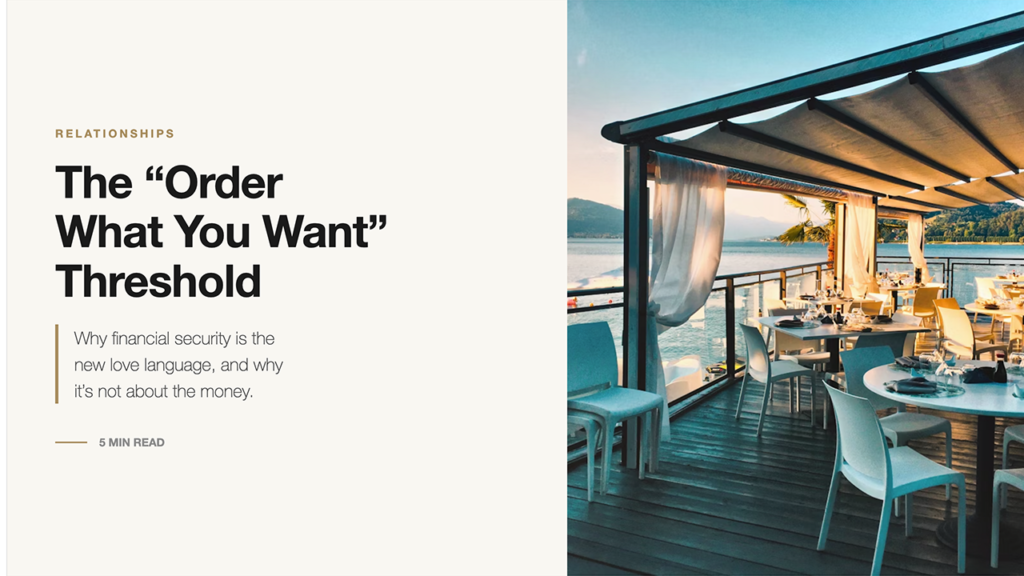
There is a specific, quiet tension that happens at a restaurant table when the menus arrive. It’s the split second where you look at your date and wonder if they’re going to do the “mental math.” You know the look: the eyes darting to the right side of the page, the subtle hesitation over the $19 appetizer, the performative “I’m not that hungry” when the sea bass looks better than the salad. When a woman says she wants a man who is “well-off,” we usually jump straight to the “gold digger” trope. We envision private jets and designer handbags. But for most women navigating the current dating landscape, the bar isn’t a yacht; it’s simply the ability to order a second cocktail without feeling like they’re bankrupting the person across from them.
Calling a woman a gold digger for wanting a financially stable partner is often a lazy way to avoid a much more uncomfortable conversation about the state of modern adulthood. We are living in an era where “average” doesn’t quite cover the bills anymore. When a woman looks for a man who invests his money and earns above the median, she isn’t necessarily looking for a ticket to Easy Street. Often, she’s looking for an exit from the anxiety of the “Project Man” — the guy who is perpetually one car breakdown or one bad month away from total collapse.
The Exhaustion of Being the Only Adult in the Room
A lot of the desire for a “financially secure” man is actually a trauma response to the Fixer-Upper Phase. Most women have spent their twenties dating men who were “in-between things,” men who treated a savings account like a myth, or men who expected their partner to act as a low-interest credit union. After years of being the only person who remembers to pay the electric bill or the one who always has to cover the Uber, the prospect of a man who has his own retirement account feels less like greed and more like a luxury vacation for the soul.
There is a deep, bone-weary exhaustion that comes from being the “responsible one” in a lopsided partnership. Searching for a man with a solid career and a savvy investment portfolio isn’t always about the money itself; it’s about the competence the money represents. It’s the desire to be with someone who has mastered the basic logistics of existing in a capitalist society so that the relationship can finally be about something more interesting than how to pay for groceries.
The Statistical Impossibility of Your “Standard”
Here is where the conversation gets a bit more jagged. While wanting stability is a basic human right, there is a massive disconnect between “financially secure” and the “top 1%.” In the United States, a man under 40 making $250,000 or more is a statistical unicorn — representing less than one percent of the population. If a woman makes an average wage and expects a partner who can fund a life of $100 dinners and spontaneous international travel, she isn’t just looking for security; she’s looking for a subsidy.
The math of the “high-value man” is often a trap. When you target a man based on a high-income bracket, you aren’t just competing with other women; you are entering a market where the power balance is inherently skewed. A man who has reached that level of financial success often has a very clear idea of what he wants in return. If his “value” is his bank account, he may expect your “value” to be something equally high-end, usually youth, extreme beauty, or a level of domestic labor that most modern professional women aren’t interested in providing. You can’t ask for a 1% lifestyle while bringing a 50% contribution to the table and expect the relationship to remain equitable.
The “Equitable Value” Reality Check
Relationships are transactional. We hate saying it because it ruins the romantic patina we like to keep over our lives, but they are. If you are looking for a man who is “savvy” and “invests his money,” you have to ask yourself why a man like that would invest in you. If he is financially secure and you are “work to live” and just getting by, what is the trade-off? If he’s bringing the steak, what are you bringing to the grill?
This is where many dating standards fall apart. We want the man who doesn’t check the price on the menu, but we also want the man who respects our career as an equal endeavor, even if our career doesn’t pay for the wine. There’s a certain hypocrisy in wanting a man to uphold traditional “provider” roles while we simultaneously reject traditional “nurturer” roles. If he is the one paying for the $300 date night every Saturday, he is, in a very real way, subsidizing your lifestyle. That creates a power dynamic that is rarely healthy and almost never “feminist.”
Security as a Reproductive Strategy
For women who want children, the “financially secure” requirement isn’t a preference; it’s a logistics plan. It is incredibly difficult to be “financially savvy” while your body is busy growing a human and your career is on a forced hiatus. In this context, looking for a man who earns well above average isn’t about greed. It’s about risk management. It’s the biological drive to ensure that if the world gets shaky, the house won’t fall down.
But even this has been warped by the Instagram-standard of parenting. There is a difference between wanting a father who can provide a safe home and wanting a father who can provide a “curated” home. We have started to conflate “providing” with “performing.” A man who can’t afford the $1,200 stroller isn’t necessarily a “loser,” but in the high-stakes world of modern dating, he often gets discarded as one. We’ve turned financial stability into a binary switch — you either have “it” or you don’t — and in the process, we’re overlooking thousands of men who are responsible, hardworking, and kind, but who simply haven’t conquered the stock market yet.
The Freedom of the $100 Dinner
Ultimately, the “order what you want” test is about freedom. It’s about the freedom from the mundane, grinding stress of poverty. We live in a world that is increasingly expensive and increasingly precarious. Finding a partner who acts as a buffer against that precarity is one of the most practical things a person can do. But we have to be honest about the cost of that buffer. If you want a man who is a financial fortress, you have to be prepared for the fact that a fortress is rarely a place of total equality. It’s a place built on someone else’s terms.