
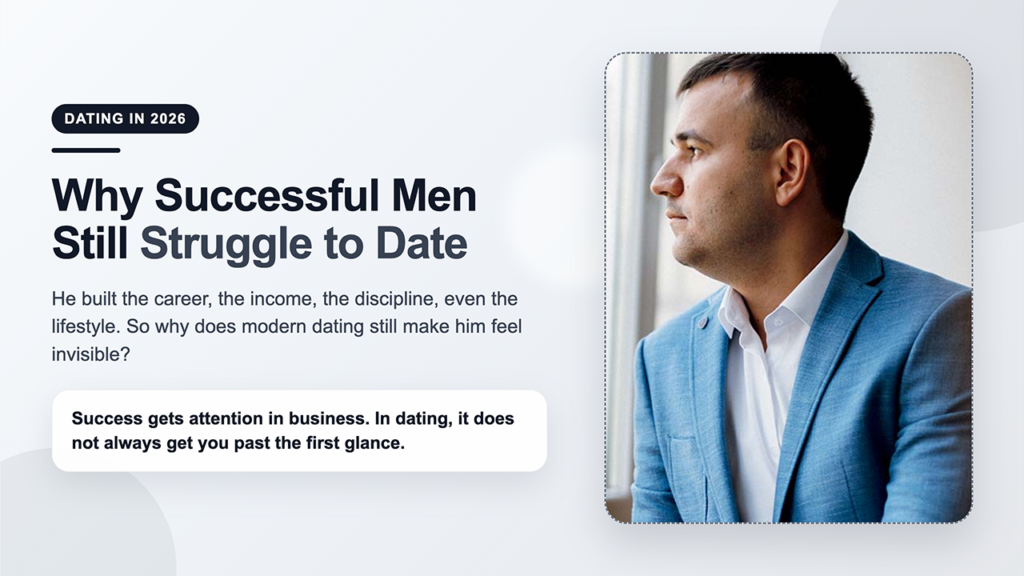
There is a particular kind of lonely man people still do not know how to talk about properly. He has a serious job. He pays his bills on time. He works out. He dresses well enough. He is not living like a disaster, not asking anyone to rescue him, not drifting through life with a PlayStation controller and a sink full of plates. On paper, he should be fine. More than fine, actually. He should be considered a catch.
And yet his phone stays quiet.
He opens a dating app and gets the same dead air he got last month. The same thin trickle of mismatched attention, bots, scammers, people who never reply, people who unmatch after one glance at a stat they do not like. He starts to feel insane. Not because dating is hard, everyone knows dating is hard, but because his struggle seems to violate the story people keep telling him. The story says men with money and status have options. The story says once a man gets his life together, romance gets easier. The story says women want stability, seriousness, and commitment. Then why does he feel invisible before he can even say hello?
This is one of the least discussed frustrations in modern dating. A man can win at the parts of life that are supposed to matter, and still lose badly in the first five seconds of attraction. He can be accomplished and still not be wanted. He can be generous and still not be desired. He can be ready for a real relationship and still feel like he is not even making it to the audition.
Modern dating rewards what scans fast, not what holds up over time
A lot of successful men are being judged inside systems that were not built to showcase their actual value. Dating apps are not neutral spaces. They are sorting machines. They reward the traits that register instantly on a screen, height, face, body proportions, style cues, social ease, the ability to look effortless in a photo. They reward men who can create a quick emotional pull before they have even said a sentence.
That is brutal for the man whose best qualities are slower. The man who is calm under pressure. The man who will call when he says he will. The man who has built a stable life brick by brick. The man who is not flashy, but deeply reliable. Those things matter in relationships. They just do not always perform well in swipe culture.
People like to pretend this is bitterness talking. It is not. It is just description. A man can be high-functioning, loyal, emotionally serious, and still get filtered out before anyone learns a thing about him. That does not mean women are evil or shallow. It means first-impression dating markets are first-impression dating markets. They are visual. They are ruthless. They compress a person into a few signals and then move on.
Money helps, but not in the way men hope
One of the most common private heartbreaks among successful men is this: they thought achievement would at least get them in the door. Not buy love, not guarantee chemistry, but at least make them visible. At least make someone pause. At least create a little grace.
Instead, many discover that money is not a cheat code. It is an amplifier. If a man is already attractive, charming, tall, socially fluid, or visually impressive, money can magnify all of that. It makes the package even more compelling. But if a man is average-looking, short, awkward, stiff on dates, or clearly carrying years of rejection in his body, money does not erase those things. Sometimes it makes them feel sharper.
That is where resentment starts to breed. Not because he expected women to throw themselves at him, but because he thought success would count for more than it does. He thought discipline would become attractive. He thought provider energy would matter. He thought maturity would have market value. Then he looks around and sees men with less substance getting more attention because they know how to create tension, flirt lightly, and look good in a mirror selfie.
It feels humiliating. That humiliation matters more than people admit.
A lot of accomplished men are socially underdeveloped, and nobody told them that would matter this much
There is another part of this that does not get enough air. Some men became successful by pouring almost everything into work, ambition, credentials, and self-control. They learned how to compete professionally, not how to charm strangers. They learned how to negotiate deals, not how to create warmth. They became impressive adults while staying romantically inexperienced in ways that are hard to confess after thirty.
You can see it in certain men the second they start talking about dating. They speak as if attraction should be measurable. They speak as if fairness should apply. They list the inputs they have optimized, income, grooming, fitness, career, and feel genuinely stunned that the output is still rejection. They are not always arrogant. Sometimes they are the opposite. They are overmanaged, overedited, and deeply uncomfortable with the messier parts of human connection.
People hear that and rush to say personality matters. True, but that phrase is too vague to be useful. What matters is not “personality” in the abstract. It is whether someone feels good around you. Whether you seem open or defended. Whether you can create play instead of pressure. Whether your attention lands as warm rather than hungry. Whether being with you feels like entering a room or entering a performance review.
A man can be good and still feel tense. He can be intelligent and still make a date feel heavy. He can mean well and still carry so much self-surveillance that the other person feels it immediately. That does not make him broken. It makes him hard to relax with.
Repeated rejection changes the way a man inhabits his own body
One of the saddest things about dating failure is how physical it becomes. At first it is disappointment. Then it becomes vigilance. A man starts monitoring himself from the outside. How he stands. How his face photographs. Where his shoulders sit. How old he looks. Whether women notice his height the moment he walks in. Whether his silence reads as confidence or awkwardness. Whether his laugh sounds forced. Whether a pause in conversation means the date is already dead.
After enough rejection, some men stop showing up as people and start showing up as collections of deficits. Too short. Too plain. Too stiff. Too old-looking or too baby-faced. Too serious. Not fun enough. Not charming enough. Not hot enough. Once a man begins narrating himself this way, dating becomes almost impossible, because he is no longer relating. He is presenting evidence against his own desirability in real time.
This is one reason advice from happy people often lands badly. They say things like “just be confident” as if confidence were a switch hidden in a kitchen drawer. But confidence is hard to fake when someone has been taught, repeatedly, that their strongest qualities do not register where they most want to be seen.
Still, this is where a lot of men get trapped. They become so fixated on the trait they believe disqualifies them that every interaction starts orbiting that wound. Height, hairline, face, age, social awkwardness, whatever it is. And once that insecurity takes center stage, it often becomes more damaging than the original trait ever was.
Some men say they want love, but what they really want is relief from humiliation
This is the part people rarely say out loud because it sounds cruel. A decent number of men are not only looking for partnership. They are looking for proof that they are not at the bottom of the romantic hierarchy. They want one woman to choose them in a way that erases the sting of every woman who did not.
That is a lot to ask another person to carry.
When a man becomes consumed by the need to finally be picked, he often starts talking about women in categories. The pretty ones. The shallow ones. The serious ones. The ones who only want tall guys. The ones who care about money. The ones who are out of his league. The ones he would “settle for.” You can feel the despair under it, but you can also feel the hardening. He is no longer imagining intimacy. He is trying to solve a status problem.
This is why some successful men drift toward fantasies of transactional dating. Not always because they are soulless or manipulative, but because they are exhausted. They start thinking, maybe sincerity is a scam, maybe romance is a market, maybe they should stop pretending and just find someone who values what they can provide. It feels cleaner. Less humiliating. More honest.
But that mindset usually reveals something painful. He is not trying to build love from a strong place. He is trying to escape the ache of feeling unwanted.
The dating market is not equally cruel to all strengths
There are strengths the current culture flatters, and strengths it delays rewarding. Men who are witty, photogenic, socially intuitive, tall, playful, and effortlessly masculine tend to perform well early. Men who are dependable, protective, thoughtful, serious, and stable often perform better later, once somebody actually knows them.
The problem is many people never make it to later.
This creates a real split between what people claim they want and what their behavior rewards upfront. A woman may genuinely want consistency, emotional steadiness, generosity, and maturity. But if the environment she is meeting men in is built around instant attraction, she may keep selecting for men who create immediate excitement instead. Not because she is foolish, but because first-stage attraction and long-term compatibility are not the same test.
Successful men who do badly in fast-market dating often sense this, but interpret it in the worst possible way. They tell themselves women do not care about substance. That is too simple. A more honest read is that substance is often invisible until context reveals it. An app profile is bad at revealing context. So is a loud bar. So is a culture that trains everyone to make snap judgments and call it intuition.
Many of these men are trying to date in environments that punish seriousness
There is also a practical problem hiding inside the emotional one. A lot of accomplished men keep searching for depth in places optimized for volume. They are looking for a real partner on platforms that reward novelty and split-second appeal. They are trying to be chosen by women who are sorting through hundreds of options while bored on a Tuesday night. They are treating repeated failure in the worst possible venue as proof of universal undesirability.
That is like bombing one type of interview and deciding you are unemployable.
Some men genuinely are in the wrong market. Not because they are superior, but because their strongest traits require friction, familiarity, and repeated contact. They do better in spaces where people can watch them over time, hear them talk when they are not trying to impress, notice how they carry themselves in a group, experience their humor when it arrives naturally, see that they are generous without theatrics and competent without bragging. In other words, they do better in actual life.
This is why so many women will say some version of the same thing: a man who would never have stood out to them on an app became incredibly attractive once they knew him in person. Men hate hearing this because it feels vague and unscalable. Fair enough. It is still true.
The hardest truth is that success does not automatically make a man relationally attractive
This is the bruise under the whole conversation. Success can make a man admirable. It can make him safe. It can make him competent, useful, disciplined, even powerful. But relational attraction asks for additional things, emotional presence, flexibility, warmth, playfulness, self-trust, the ability to make another person feel seen instead of assessed.
A man may have spent fifteen years becoming impressive and almost no time becoming easy to know. He may have built a fantastic life that still feels sealed off. He may think his problem is that women are shallow, when the more uncomfortable truth is that he has become highly optimized for achievement and strangely inaccessible in intimacy.
That does not mean the solution is to become fake, louder, or more “alpha.” Usually it means the opposite. Less performance. Less scorekeeping. Less obsessing over whether every woman finds him physically ideal. More texture. More humanity. More actual life beyond work, beyond gym mirrors, beyond trying to become acceptable enough to finally be loved.
Because one of the most recognizable dating tragedies of this era is the man who did everything right on paper, then slowly built his identity around the idea that being chosen would finally prove he mattered. He is not struggling because success means nothing. He is struggling because success solved the parts of life that obey effort, and dating still contains a humiliating amount of mystery, timing, chemistry, and emotional signal that cannot be brute-forced.
And for men who have spent their whole lives surviving by being competent, that may be the most insulting part of all.